
The three-month gap that isn't
The EU's new rules on green claims have applied since 27 September. Sweden's law comes later. The duty to prove a claim doesn't wait.
What changed on 27 September
Directive (EU) 2024/825 required Member States to adopt their rules by 27 March 2026 and to apply them from 27 September 2026 [1]. It added new items to the EU list of commercial practices that are banned in all circumstances. Four of them matter most for cups, lids and other packaging [1]:
Generic claims. "Making a generic environmental claim for which the trader is not able to demonstrate recognised excellent environmental performance relevant to the claim." In practice that means "eco", "green" and "eco-friendly" without an EU Ecolabel, an officially recognised ISO 14024 type I ecolabel, or top performance under other EU law.
Part for whole. "Making an environmental claim about the entire product … when it concerns only a certain aspect of the product."
Home-made labels. "Displaying a sustainability label that is not based on a certification scheme or not established by public authorities."
Legal requirements sold as features. "Presenting requirements imposed by law on all products within the relevant product category on the Union market as a distinctive feature of the trader's offer."
The last one deserves a second look. Since 12 August 2026, the EU Packaging and Packaging Waste Regulation has limited PFAS in all food-contact packaging [14]. Marketing "PFAS-free" as the thing that sets a cup apart now risks falling under this ban. That is our reading; how authorities apply it remains to be seen.
Who was ready
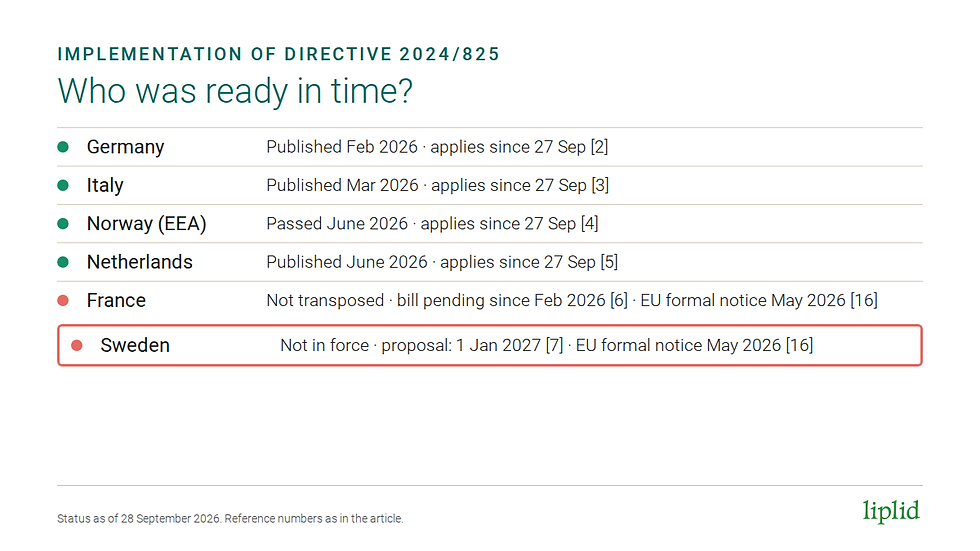
Most large markets had their laws in place. Germany published its amendment to the Unfair Competition Act in February 2026, applying from 27 September [2]. Italy's decree was published in the Official Gazette in March, with most provisions applicable from 27 September [3]. Norway, which is in the EEA but not the EU, passed its law in June and has applied it since 27 September [4]. The Netherlands published its law in June, and the government says the stricter rules have applied since 27 September [5].
France missed the date. Its transposing bill passed the Senate in February 2026 and has sat with the National Assembly ever since, without a committee report or a vote [6].
Sweden has no law yet. The government inquiry SOU 2025:124 proposes that the changes take effect on 1 January 2027 [7]. Konsumentverket, the Swedish Consumer Agency, says it is waiting for national legislation that "ännu inte är beslutad" (Swedish: "has not yet been decided") [8]. No government bill had been presented by late September [7].
The Commission had noticed. On 28 May 2026 it sent letters of formal notice, the first formal step of an infringement procedure, to 20 Member States that had not notified full transposition by the March deadline. France, the Netherlands, Sweden and Finland were among them; Germany and Italy were not [16]. The Netherlands has since published its law.

Why the gap isn't a grace period
The Swedish Marketing Act already forbids incorrect claims about a product's "inverkan på hälsa och miljö" (impact on health and the environment) [9]. Violations can lead to a market disruption fee of up to 4% of annual turnover [9].
The case law is also clear. In a 2022 ruling on environmental claims for an insulation product, the Patent and Market Court of Appeal said the marketer carries the burden of proving that a claim is correct, and that "höga krav" (high demands) apply to the reliability of environmental claims [10]. As early as 2011, the Market Court said a general claim like "miljövänlig" (environmentally friendly) is vague and "bör undvikas" (should be avoided) unless it is clearly qualified [11]. Konsumentverket's own guidance says a company must be able to prove the average consumer's overall impression of a claim, not just what it meant to say [8].
"Plastic free" is not a generic claim at all. It is a specific factual claim. If a cup must carry the EU's "PLASTIC IN PRODUCT" marking [12], calling it plastic free is already misleading under today's rules.
What 27 September added is certainty: some claims are now banned outright, with no case-by-case assessment of whether anyone was misled. Sweden gets that list when its law is in place, proposed for 1 January. The duty to back a claim with evidence is already there.
The one real softening: old stock
There is a genuine grace period, but it is about packaging already made, and it applies everywhere, not only in Sweden. In June 2026, the national consumer authorities in the EU's Consumer Protection Cooperation network agreed a common understanding on "old stock": products "manufactured, ordered, distributed or placed on retailers' shelves" before 27 September [17]. Authorities are to take a "compliance-oriented before sanction-oriented approach" and "refrain from requiring the destruction or recall of products" where traders face genuine transition problems [17].
It is not legally binding and has no end date. It also expects traders "to move towards compliance without delay and in good faith", and notes that online claims "do not face the same challenges as offline claims" [17]. A pallet of printed cups may get time. The same claim on a website or a menu probably won't.
Does anyone enforce this on packaging?
Sometimes. In 2023 the Consumer Ombudsman won a case at the Patent and Market Court against a "net zero climate footprint" claim printed on milk cartons. The claim was banned, backed by a conditional fine of SEK 1 million [13]. That was a claim on the packaging about the product inside.
We found no published Swedish case concerning claims about the packaging material itself, such as "plastic free", "compostable" or "recyclable" on a cup or lid. Absence of published cases is not proof that nothing has happened, but it suggests packaging-material claims have not been an enforcement priority.
For context, when the Commission and national authorities screened green claims online in 2020, they found 42% could be false or deceptive and 59% lacked easily accessible evidence [15].
The honest caveats
Not all delay is equal. Sweden's transposition is late, but the underlying ban on misleading environmental claims has applied for years.
Legal detail varies by country. Each national law can differ in wording and in how quickly authorities act. This article is not legal advice.
Old-stock tolerance is guidance, not law. How each authority applies it, and for how long, will vary.
Status can change fast. A Swedish bill or a French vote may appear any week. The status above is as of 28 September 2026.
Where we stand
LIPLID makes fibre lids and cups, so these rules apply to our own claims too. We think the industry is better off when every claim on a cup comes with evidence a buyer can check, including ours.
A question for buyers
When did a supplier last send you the evidence behind the green word on your cups?
References
Directive (EU) 2024/825 amending Directives 2005/29/EC and 2011/83/EU as regards empowering consumers for the green transition. Art. 4; Annex (new points 2a, 4a, 4b, 10a of Annex I to Directive 2005/29/EC). https://eur-lex.europa.eu/legal-content/EN/TXT/HTML/?uri=CELEX:32024L0825
IHK Lippe zu Detmold. Greenwashing verboten: EmpCo-Umsetzungsgesetz veröffentlicht (3. Gesetz zur Änderung des UWG, BGBl. 2026 Nr. 43, 19 February 2026) (in German). https://www.ihk.de/lippe-detmold/hauptnavigation/beraten-und-informieren/umweltschutz/aktuelles1/greenwashing-verboten-uwg-6956954
Rete Clima. D.lgs. 20 febbraio 2026, n. 30: l'Italia recepisce la Direttiva … (Gazzetta Ufficiale, 9 March 2026) (in Italian). https://www.reteclima.it/d-lgs-20-febbraio-2026-n-30-italia-greenwashing-aziende/
Stortinget, case on amendments to the Marketing Control Act (Lovvedtak 85 (2025–2026), adopted 15 June 2026) (in Norwegian). https://www.stortinget.no/no/Saker-og-publikasjoner/Saker/Sak/?p=200129 · NHO Service og Handel, 11 May 2026 (application 27 September 2026). https://www.nhosh.no/bransjer/handel2/nyheter/2026/nye-krav-til-gronn-markedsforing-kan-du-ikke-dokumentere-det-skriv-det-ikke/
Eerste Kamer, wetsvoorstel 36.873, Implementatiewet richtlijn betere duurzaamheidsinformatie voor consumenten (Stb. 2026, 152) (in Dutch). https://www.eerstekamer.nl/wetsvoorstel/36873_implementatiewet_richtlijn · Ondernemersplein (Dutch government business portal). Duurzaamheidsclaims moeten duidelijk en controleerbaar zijn (in Dutch). https://ondernemersplein.overheid.nl/wetswijzigingen/duurzaamheidsclaims-moeten-duidelijk-en-controleerbaar-zijn/
Assemblée nationale. Projet de loi portant diverses dispositions d'adaptation au droit de l'Union européenne…, legislative file (in French). https://www.assemblee-nationale.fr/dyn/17/dossiers/DLR5L17N53140 · Village Justice. Allégations environnementales : depuis le 27 septembre 2026, la directive s'applique, la France n'a pas transposé, 28 September 2026 (in French). https://www.village-justice.com/articles/allegations-environnementales-septembre-2026-directive-applique-france-pas,59252.html · DGCCRF fact sheet (in French). https://www.economie.gouv.fr/dgccrf/les-fiches-pratiques/larsenal-juridique-de-la-lutte-contre-lecoblanchiment-bientot-complete
Regeringen. Åtgärder för en mer hållbar konsumtion, SOU 2025:124, 19 January 2026 (in Swedish). https://www.regeringen.se/rattsliga-dokument/statens-offentliga-utredningar/2026/01/sou-2025124/ · Regeringen, list of government bills (in Swedish). https://www.regeringen.se/rattsliga-dokument/proposition/
Konsumentverket. Miljöpåståenden – regler för företag (in Swedish). https://www.konsumentverket.se/marknadsratt-foretag/miljopastaenden-regler-for-foretag/
Marknadsföringslag (2008:486), 8, 10 and 29 §§ (in Swedish). https://www.riksdagen.se/sv/dokument-och-lagar/dokument/svensk-forfattningssamling/marknadsforingslag-2008486_sfs-2008-486/
Patent- och marknadsöverdomstolen, PMÖD 2022:3, 25 March 2022 (in Swedish). https://lagen.nu/dom/pmod/2022:3
Marknadsdomstolen, MD 2011:12, 31 May 2011 (in Swedish). https://lagen.nu/dom/md/2011:12
Commission Implementing Regulation (EU) 2020/2151, Annex IV (marking of beverage cups). https://eur-lex.europa.eu/legal-content/EN/TXT/HTML/?uri=CELEX:32020R2151
Stockholms tingsrätt, Patent- och marknadsdomstolen, judgment of 2 February 2023, case PMT 17372-21 (in Swedish). https://www.forbrukertilsynet.no/wp-content/uploads/2024/04/dom-arla-netto-noll-stockholms-tr-pmt-17372-21-dom-2023-02-02.pdf
Food Packaging Forum. PPWR PFAS limits apply from August 12, 12 August 2026 (Regulation (EU) 2025/40). https://foodpackagingforum.org/news/ppwr-pfas-limits-apply-from-august-12
European Commission. Screening of websites for 'greenwashing': half of green claims lack evidence, IP/21/269, 28 January 2021. https://ec.europa.eu/commission/presscorner/api/files/document/print/en/ip_21_269/IP_21_269_EN.pdf
European Commission. Infringement decisions, INF/26/1097, 28 May 2026 (section on Directive (EU) 2024/825). https://ec.europa.eu/commission/presscorner/api/files/document/print/en/inf_26_1097/INF_26_1097_EN.pdf
Consumer Protection Cooperation Network. Common understanding on old stock situations under Directive (EU) 2024/825, June 2026. https://commission.europa.eu/document/download/264d8c70-2f9a-4955-8e7b-154d55a9b684_en?filename=Final+CPC+common+understanding+on+old+stock+situations+June+2026.pdf
Further reading
Directive (EU) 2024/825 on EUR-Lex. The definitions and the new blacklist are short and readable. It also defines what counts as "recognised excellent environmental performance".
Konsumentverket: Miljöpåståenden – regler för företag (Swedish). The Swedish authority's current guidance on what a green claim must live up to, which applies right now, before the new law arrives.